What Is the True Monthly Cost of Living in Atlanta, GA 2026?

Atlanta is a bustling, dynamic metropolis known for its dense tree canopy, diverse culinary scene, and growing technology, business, and entertainment sectors.
For professionals and families considering a move in 2026, understanding the cost of living in Atlanta, GA, means looking beyond home prices. Buyers should evaluate the complete monthly cost of a property rather than looking only at the purchase price.
Housing, utilities, transportation, groceries, taxes, insurance, and everyday entertainment can all have a meaningful effect on a household budget.
Current cost-of-living estimates generally place Atlanta close to the national average overall, although housing and transportation can create significant differences between households.
This guide breaks down the major expenses to help prospective homebuyers build a realistic picture of what it costs to live in Atlanta.
Understanding the Cost of Living in Atlanta, GA
The cost of living in Atlanta, GA, is generally considered moderate compared to other major coastal cities like New York or Los Angeles. While housing prices have increased, using an Atlanta affordability guide helps new residents find incredible value, making Atlanta's overall cost of living highly attractive for relocating professionals.

Analyzing the Average Cost of Living in Atlanta, GA
Everyday Budgeting Basics
When calculating the average cost of living in Atlanta, GA, everyday expenses deserve just as much attention as housing.
Utilities can be particularly important during Atlanta's hot, humid summers. Air conditioning can increase electricity consumption during the warmer months, making utility bills less predictable than a simple annual average suggests.
Current Atlanta cost estimates put basic utilities for a typical 85-square-meter apartment at roughly $185 per month, although actual bills vary according to property size, energy efficiency, household usage, and the season.
Internet and mobile service can add another $100 or more per month, depending on the plans selected.
Groceries are relatively close to national levels, although individual shopping habits make a major difference. A current Atlanta estimate puts groceries for one person at roughly $450 per month.
Families, people who cook frequently, and households purchasing specialty foods will naturally spend more.

Transportation and Commuting
Transportation is one of the biggest variables in the cost of living in Atlanta, Georgia.
MARTA provides rail and bus service throughout parts of the city and surrounding communities, and a regular monthly transit pass is about $99. For residents living and working near MARTA, public transportation can substantially reduce the cost of owning and maintaining a vehicle.
For many metro Atlanta residents, however, a car remains important. Monthly transportation expenses can include a vehicle payment, gasoline, insurance, maintenance, registration, parking, and occasional tolls or rideshare costs.
The Atlanta Regional Commission's 2025 commuter survey continues to track how residents across the 20-county region travel to work, highlighting the wide range of commuting patterns throughout metro Atlanta. Where you choose to live can therefore have a meaningful effect on both your transportation costs and your available free time.
Navigating Atlanta Housing Costs and Real Estate
Accessible Homeownership
A significant portion of most household budgets goes toward Atlanta housing costs. The city and surrounding metro offer everything from downtown and Midtown condominiums to established neighborhoods and larger suburban properties.
Current 2026 market data illustrates why buyers should avoid relying on one citywide number.
Redfin's Atlanta cost-of-living data places the typical house price around $419,000 and the typical apartment rent around $1,487 per month. Other sources produce different estimates because they use different property types, geographic boundaries, and calculation methods.
Suburban markets such as Marietta and Alpharetta can provide different combinations of home size, schools, commute times, property taxes, and amenities. A lower purchase price does not necessarily mean a lower monthly cost if the property requires a longer commute or carries higher insurance, maintenance, or tax expenses.
Rent vs Buy Dynamics
Renting can provide flexibility, particularly for someone who is still learning Atlanta's neighborhoods. Renting closer to central employment districts can also reduce commuting time, although properties in highly sought-after areas may command higher rents.
Buying introduces additional costs, including the mortgage, property taxes, homeowners' insurance, maintenance, possible homeowners' association dues, and closing costs. It also creates the opportunity to build home equity as the mortgage principal is paid down, although future home values are never guaranteed.
For buyers planning to stay in Atlanta for several years, comparing the total cost of ownership with comparable rent can provide a more useful starting point than comparing a mortgage payment with rent alone.

Managing Atlanta, GA Monthly Living Expenses
Entertainment and Dining Out
Atlanta offers a wide range of entertainment, restaurants, sporting events, concerts, museums, parks, and cultural attractions. These expenses are discretionary, but they can quickly become a noticeable part of Atlanta, GA's monthly living expenses.
For example, current Atlanta consumer-price estimates put an inexpensive restaurant meal around $27.50 and a three-course meal for two at a mid-range restaurant around $110, before drinks and gratuity.
Residents can control this category considerably by mixing restaurant meals and entertainment with Atlanta's many parks, trails, public spaces, and free or lower-cost community events.
Healthcare and Groceries
Healthcare costs depend heavily on insurance coverage, employer benefits, household size, prescriptions, and individual medical needs. Atlanta is home to major healthcare systems and medical facilities, but access to high-quality medical care does not mean every household will have low healthcare expenses.
Groceries are another relatively manageable but variable expense. Tracking your living expenses in Atlanta over several months can reveal spending patterns that are difficult to predict before moving.
For homebuyers, the key is to build a budget that includes healthcare premiums and out-of-pocket costs rather than treating healthcare as an occasional expense.

Your Complete Atlanta Affordability Guide
Maximizing Your Budget
A practical Atlanta affordability guide should start with location.
Living on the same side of the metro area as your workplace can reduce fuel, vehicle wear, parking expenses, and commuting time. This can be especially valuable in a region where major highways and interchanges can experience substantial congestion.
Buyers should also compare the total monthly cost of homes rather than simply searching for the lowest listing price. A property with a slightly higher purchase price may have different insurance, tax, HOA, maintenance, or transportation costs.
Evaluating Tax Implications
Property taxes are another important component of the monthly housing budget.
Atlanta-area property taxes can vary according to the property's assessed value and the taxing jurisdictions that apply to it. Fulton County, DeKalb County, municipalities, school districts, and other taxing authorities can each affect the final tax bill.
Fulton County's 2026 budget maintains the county property tax rate at 8.87 mills, while the City of Atlanta also has its own millage components. Buyers should therefore verify the specific tax history and applicable rates for an individual property before estimating their monthly escrow payment.
Georgia's 2026 state income tax rate is 4.99%, another factor that should be incorporated when calculating take-home income and a realistic household budget.
Atlanta Cost Comparison Table
The following table provides a practical high-level comparison. Actual expenses vary by household, neighborhood, property type, and lifestyle.
| Expense Category | Atlanta Market Impact | National Average Comparison |
|---|---|---|
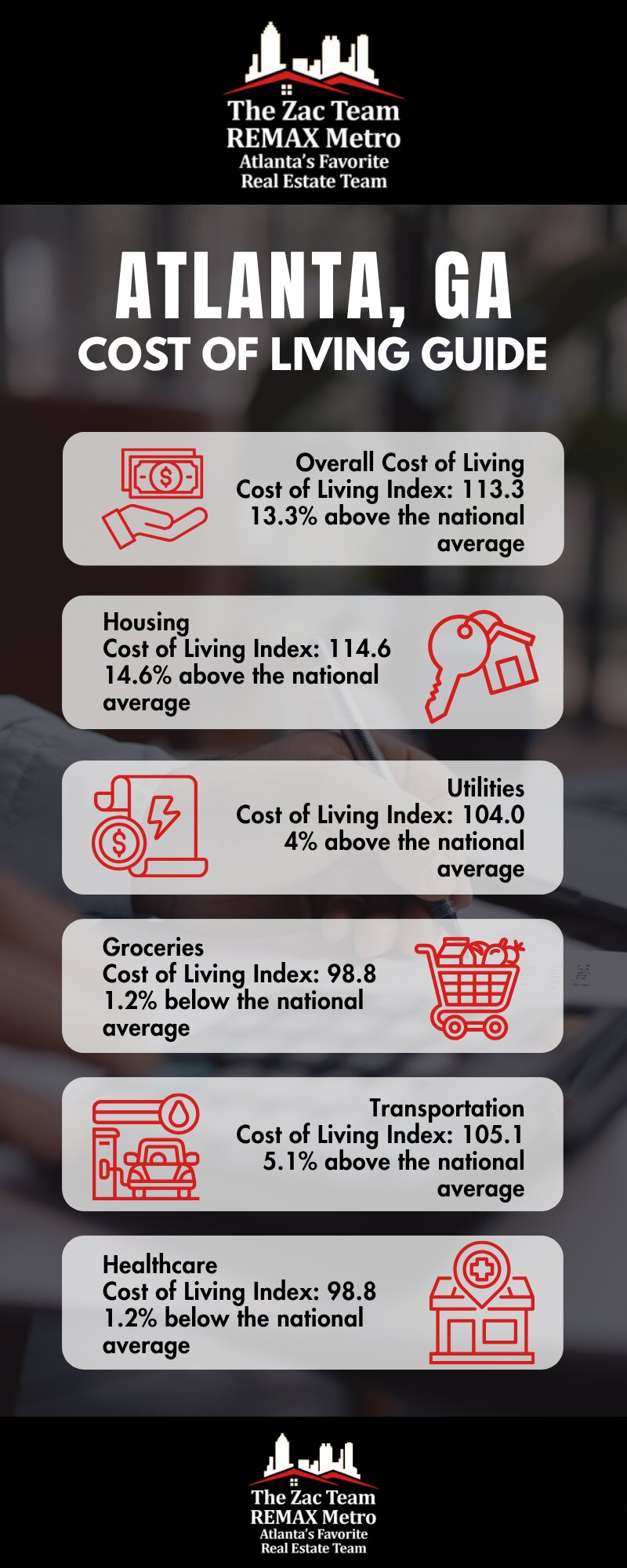
| Housing (Mortgage/Rent) | Moderate to Premium | About 14.6% above the national average |
| Utilities | Seasonal impact from summer cooling | About 4% above the national average |
| Groceries | Standard | About 1.2% below the national average |
| Transportation | High for many car-dependent households | About 5.1% above the national average |
| Healthcare | Major regional medical options; individual costs vary | About 1.2% below the national average |
It is worth noting that cost-of-living sources can produce different results. For example, one 2026 estimate places Atlanta's overall cost of living about 7% below the national average, while another places it about 8% above it.
These differences reflect variations in methodology, housing assumptions, geographic definitions, and spending models. There is no single monthly figure that accurately represents every Atlanta household.
Maximize Your Purchasing Power in the South
Understanding the cost of living in Atlanta, GA requires more than checking the average home price. Housing, transportation, utilities, groceries, taxes, insurance, and personal spending all contribute to the actual monthly cost of living.
The average cost of living in Atlanta GA can be manageable for many households, but the right budget depends heavily on where you live and how you commute. A buyer who prioritizes a shorter commute may spend more on housing but less on transportation, while someone purchasing farther from central Atlanta may find a larger home but take on higher commuting costs.
Before purchasing, compare the full monthly payment—including principal, interest, taxes, insurance, HOA fees where applicable, and an allowance for maintenance—with your expected Atlanta GA monthly living expenses.
With a realistic budget and a clear understanding of local Atlanta housing costs, buyers can narrow their search to properties that fit both their lifestyle and finances. Whether you're moving for work, buying your first home, or looking for more space, understanding the living cost in Atlanta is an important first step.
If you're planning to buy a home in Atlanta and want to understand what your actual monthly costs could look like, reach out to Zac at (404) 564-7272 or zac@zac.biz. A local real estate professional can help you compare neighborhoods, property taxes, housing payments, commute considerations, and other expenses so you can make a more informed home-buying decision.
Frequently Asked Questions
Is the cost of living in Atlanta GA lower than in Miami or Washington, DC?
Atlanta can be less expensive than some major coastal markets, particularly in housing, but the difference depends on the neighborhood, property type, and household's transportation needs. Miami and Washington, DC also contain a wide range of housing markets, so citywide comparisons should be treated as broad estimates rather than a guarantee of savings.
What are the average Atlanta housing costs for a single-family home in 2026?
There is no single figure that represents every single-family home in Atlanta. Current 2026 market data places the typical Atlanta home around the low-$400,000 range, but prices vary significantly by neighborhood, size, condition, school district, and proximity to employment centers. Buyers should evaluate recent comparable sales for the specific area they are considering.
How does the average cost of living in Atlanta GA impact everyday groceries?
Atlanta grocery prices are generally close to national levels, although specific products can be higher or lower. A single person's grocery budget can easily reach several hundred dollars per month, with household size, dietary preferences, and shopping habits being the biggest variables.
What is a realistic monthly budget for living expenses in Atlanta, GA, for a single professional?
A single professional renting an apartment may reasonably need several thousand dollars per month after combining housing, utilities, transportation, groceries, insurance, dining, and personal expenses. Housing and transportation are usually the two categories that create the largest differences between individual budgets.
Are living expenses in Atlanta manageable without owning a car?
Yes, but location is critical. Living near MARTA rail or reliable bus service and keeping work, shopping, and entertainment nearby can make a car-free lifestyle considerably easier. Someone living farther into the suburbs may find that a vehicle is much more practical.
How has the cost of living in Atlanta, Georgia, changed for renters recently?
Rental costs fluctuate by neighborhood, property type, and market conditions. Current 2026 estimates put Atlanta apartment rents below some recent peaks, but renters should compare several properties and account for parking, utilities, pet fees, amenity fees, and other recurring charges when calculating the true monthly cost.
What should a comprehensive Atlanta affordability guide include regarding summer utilities?
It should account for higher electricity consumption during Atlanta's hot summer months. Air-conditioning use can cause significant seasonal variation, so buyers and renters should ask about previous utility bills where possible and consider the property's age, insulation, HVAC system, windows, and overall energy efficiency.
Recent Posts