
What Happens When a Home Appraisal Comes in Low in Atlanta?
Buying a home in Atlanta is an exciting milestone, but an unexpected appraisal can complicate the process.
After your offer is accepted, your mortgage lender will typically require an independent property valuation to confirm that the home is worth the amount you agreed to pay. If the appraisal comes in below the purchase price, you may face a financing gap that needs to be resolved before closing.
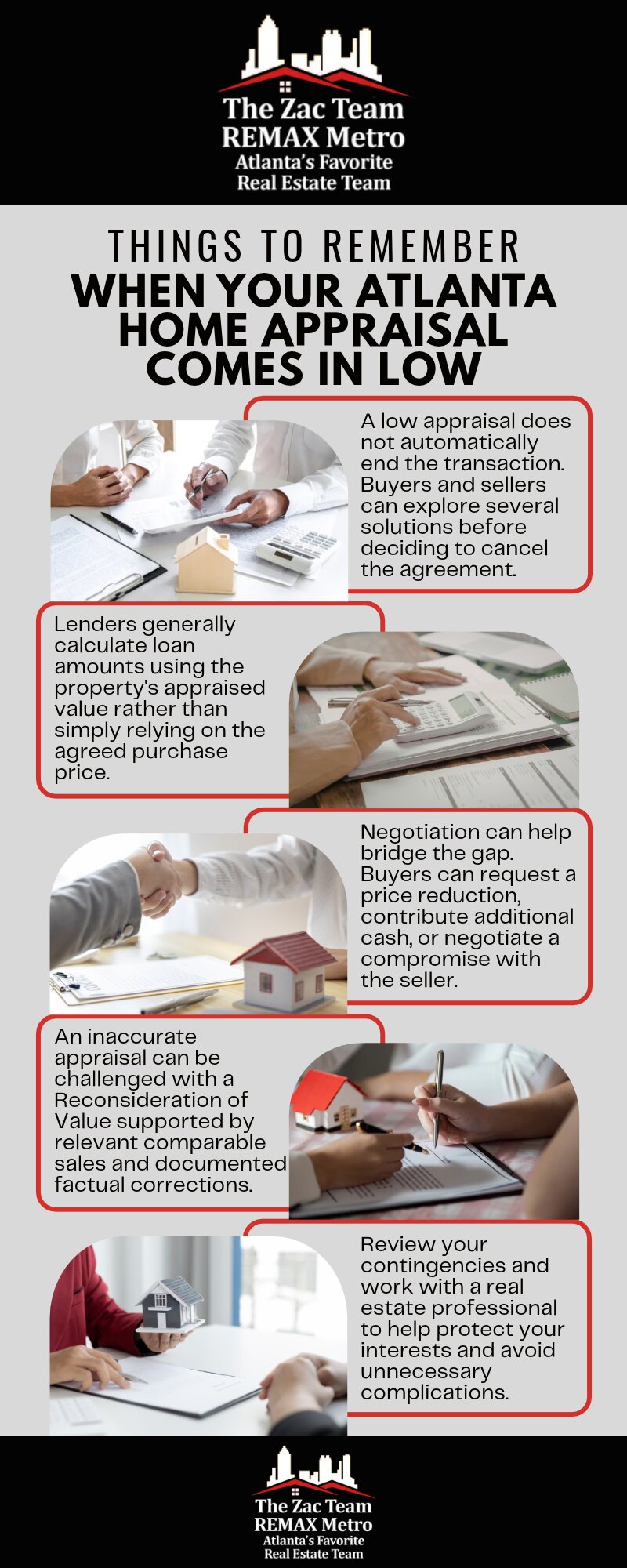
A low home appraisal in Atlanta does not necessarily mean you have to walk away from your dream home. Buyers and sellers have several options, including renegotiating the purchase price, contributing additional cash, or requesting a review of the appraisal.
Understanding these choices can help you make informed decisions and keep your transaction moving forward.
Understanding a Low Home Appraisal in Atlanta
When a low home appraisal in Atlanta occurs, the licensed appraiser values the property below the agreed-upon contract price. Because mortgage lenders base loan amounts on the appraised value rather than the offer price, buyers and sellers must renegotiate the price, cover the cash difference, or cancel the contract.
Why Does an Atlanta Home Appraisal Come in Below Price?
Several factors can explain why an Atlanta home appraisal is lower than the agreed purchase price. Understanding these reasons can help you determine whether the valuation is reasonable or deserves further review.
Rapidly Shifting Neighborhood Comparables
Appraisers typically evaluate recently sold properties, commonly called comparable sales or comps, to estimate a home's market value. These properties should have similar characteristics, such as location, size, condition, age, and features.
In Atlanta, property values can vary considerably between neighborhoods and even within smaller residential areas. A home in Virginia-Highland, for example, may have a different market profile from a comparable-looking property in East Cobb.
When neighborhood prices change quickly, recent comparable sales may not fully reflect current buyer demand. An appraiser who selects properties from a different micro-market or relies on less relevant sales could arrive at a valuation that does not accurately represent the home's competitive position.
Bidding Wars and Renovation Value
Competition among buyers can also contribute to an Atlanta home appraisal below price. When several buyers compete for the same property, the winning offer may exceed what recent comparable sales support.
Renovations create another potential difference. A seller may have invested substantially in updated kitchens, bathrooms, flooring, or outdoor living spaces. Although these improvements can make a home more attractive, appraisers do not automatically add their full renovation costs to the property's value.
Instead, they consider how those improvements affect the home's marketability and compare it with similar properties. As a result, a buyer may agree to pay a premium that the appraisal does not support.
Low Appraisal Home Buying Options
If your appraisal comes in below the purchase price, you do not have to make an immediate decision to cancel the transaction. Consider these common low appraisal home buying options.

Renegotiating the Purchase Price
One of the simplest solutions is asking the seller to reduce the purchase price to match the appraised value.
For example, if the agreed price is $500,000 and the appraisal is $485,000, you could request that the seller accept the lower amount. This reduces the amount you need to finance and avoids having to contribute additional cash solely to cover the difference.
Your negotiating position may be stronger if your purchase agreement includes an appraisal contingency. Sellers may also be more willing to negotiate if they believe another financed buyer could encounter the same valuation problem.
However, the seller is not automatically required to accept your proposed price reduction.
Bridging the Appraisal Gap in Atlanta
If the seller refuses to lower the price, you may choose to pay the difference using your own funds.
For instance, a $500,000 purchase price and a $485,000 appraisal create a $15,000 appraisal gap. You could bring that additional amount to closing on top of your planned down payment and other closing costs.
Before agreeing, ask your lender to explain how the lower appraisal affects your loan amount and required down payment. Make sure you can comfortably afford the additional expense without exhausting your emergency savings.
Challenging the Valuation and Alternative Solutions
If neither party wants to absorb the entire appraisal difference, other approaches may help keep the transaction together.

Splitting the Difference
Buyers and sellers can negotiate a compromise by sharing the appraisal shortfall.
For example, if the appraisal is $15,000 below the contract price, the seller could reduce the price by $7,500 while the buyer contributes the remaining $7,500 in additional cash.
This arrangement reduces the financial burden on both parties. It can be particularly useful when the buyer wants the property but cannot comfortably cover the entire gap, and the seller wants to avoid putting the home back on the market.
The final agreement should clearly document the revised purchase price and any additional buyer contribution.

Filing a Reconsideration of Value (ROV)
Sometimes, an appraisal contains factual errors or overlooks information that could affect the property's valuation. In these situations, you may ask your lender about submitting a Reconsideration of Value (ROV).
An ROV is a formal request for the appraisal to be reviewed based on specific, objective information. Potential supporting evidence includes:
- Incorrect property measurements or square footage.
- Finished living areas or significant improvements that were overlooked.
- Recent comparable sales that were not considered.
- Incorrect information about the property's condition or features.
- Factual mistakes in the appraisal report.
Your real estate agent can help gather relevant sales data and property documentation. Submit the request through your lender rather than attempting to pressure the appraiser directly.
An ROV does not guarantee a higher valuation. However, when supported by credible evidence, it provides an opportunity to correct errors or address weaknesses in the original report.
Next Steps When Facing a Low Home Appraisal
Once you receive disappointing appraisal results, acting quickly is important. Your next decisions may affect your financing, closing schedule, and earnest money deposit.

Reviewing Your Contract Contingencies
Start by reviewing your Georgia Association of REALTORS® (GAR) Purchase and Sale Agreement with your real estate agent. Pay particular attention to the appraisal contingency, financing contingency, and applicable deadlines.
An appraisal contingency may provide specific rights if the property's valuation falls below the agreed purchase price. However, the protection depends on the exact language of your signed agreement and whether you follow the required procedures within the stated timeframes.
Do not assume that a low appraisal automatically allows you to cancel the contract and recover your earnest money. Missing a deadline or failing to provide the required notice could affect your contractual rights.
If you are unsure about your obligations, consult a qualified Georgia real estate attorney before taking action.
Partnering with a Local Atlanta Specialist
An experienced Atlanta real estate agent can make a meaningful difference when dealing with an appraisal shortfall.
Local market knowledge helps buyers and sellers evaluate whether the appraiser selected appropriate comparable properties and whether the contract price reflects current neighborhood conditions.
Before the appraisal, your agent can prepare relevant information about the property, including recent comparable sales, improvements, square footage, and features that may influence market value.
Although agents cannot guarantee an appraised value or influence an appraiser's independent judgment, providing accurate property information can help ensure important details are available for consideration.
If an appraisal comes in low, a knowledgeable agent can also coordinate negotiations, communicate with the lender, and help you evaluate your available options.
Low Appraisal Resolution Strategies Comparison Table
Not every solution works for every transaction. The best approach depends on your available cash, the seller's flexibility, the purchase agreement, and how important the property is to you.
Here is a comparison of the most common strategies:
| Resolution Strategy | Financial Impact on Buyer | Financial Impact on Seller | Best Suited For |
|---|---|---|---|
| Seller Price Reduction | Saves cash; mortgage can be recalculated using the lower price and appraisal | Reduces gross sale proceeds | Buyers seeking to avoid additional out-of-pocket expenses |
| Buyer Pays Appraisal Gap | Requires additional cash at closing | Receives the full agreed-upon contract price | Buyers with sufficient savings in competitive markets |
| Splitting the Difference | Requires a moderate additional cash contribution | Accepts a moderate reduction in sale proceeds | Buyers and sellers willing to compromise |
| Reconsideration of Value (ROV) | May avoid additional cash if the appraisal is revised upward; could delay closing | May preserve the agreed-upon price | Transactions involving documented appraisal errors or unsupported valuations |
| Walk Away (Contingency) | May recover earnest money if contract requirements are satisfied; appraisal fees and other costs may not be recoverable | Must remarket the property and seek another buyer | Buyers with applicable contractual protections who cannot justify the price |
Before choosing a strategy, ask your lender to calculate the revised financing requirements. A seemingly small appraisal difference can affect your down payment, loan-to-value ratio, and closing budget.
Keeping Your Atlanta Real Estate Transaction on Track
A low appraisal can be frustrating, particularly when you have already invested time, money, and energy into purchasing a home. However, an appraisal shortfall does not have to end your transaction.
Understanding your low appraisal home-buying options puts you in a better position to negotiate confidently. You might request a price reduction, contribute additional funds, split the difference with the seller, or challenge an inaccurate valuation through an ROV.
The Atlanta housing market also requires buyers to pay attention to changing conditions. According to Redfin, Atlanta's median home sale price reached approximately $399,722 in October 2026, representing a 2.5% increase compared with the previous year. However, market conditions vary across neighborhoods, making property-specific comparable sales especially important.
Whether you are purchasing your first home or selling an existing property, working with an experienced local real estate professional can help you navigate an appraisal gap in Atlanta. With the right preparation and negotiation strategy, you can protect your financial interests while keeping your transaction on track.
Need help navigating a low home appraisal in Atlanta? Get in touch with me for knowledgeable guidance throughout your real estate transaction. Whether you need help evaluating an appraisal, negotiating with a seller, or finding a property that fits your budget, I can help you take the next step with confidence. Give me a call today at +1 (404) 564-7272 or email me at zac@zac.biz to discuss your real estate goals.
Frequently Asked Questions
What happens immediately after a low home appraisal in Atlanta?
Your lender will generally use the appraised value rather than the contract price when determining your maximum mortgage amount. You should review the appraisal report, discuss the financing impact with your lender, and consult your real estate agent about negotiating a price reduction, covering the difference, or requesting an appraisal review.
Can a buyer back out of a contract if an Atlanta home appraisal comes in below price?
Possibly. Your ability to terminate the agreement without losing your earnest money depends on the appraisal and financing contingencies in your signed purchase agreement, including applicable deadlines and notice requirements. Review your contract with your agent and consult a Georgia real estate attorney if necessary.
How do buyers cover an appraisal gap in Atlanta?
Buyers can cover an appraisal gap using additional personal funds, provided their lender's requirements are satisfied. Other options include negotiating a lower purchase price, splitting the difference with the seller, or requesting a reconsideration of value. Discuss the financial implications with your lender before committing to additional expenses.
How often does an Atlanta real estate appraisal get overturned after a challenge?
There is no reliable, universally applicable public statistic establishing how often Atlanta appraisals are successfully overturned. Results depend on the circumstances and supporting evidence. A reconsideration of value is more likely to receive meaningful consideration when it identifies specific factual errors, unsupported adjustments, or relevant comparable sales that were overlooked. An upward revision is never guaranteed.
Why are low home appraisals common in certain Atlanta neighborhoods?
Neighborhoods experiencing rapid price changes, competitive bidding, or limited comparable sales can be more susceptible to valuation differences. Atlanta's diverse housing market also means that properties just a short distance apart may have significantly different features and market values. Selecting appropriate neighborhood comparables is essential to an accurate valuation.
What are the best low appraisal home buying options for first-time buyers?
First-time buyers should generally start by asking the seller to reconsider the purchase price. This can help prevent unexpected cash requirements. They can also explore splitting the difference or requesting an ROV if the report contains errors. Paying the entire appraisal gap out of pocket should only be considered after carefully reviewing their finances and maintaining sufficient savings for emergencies and homeownership expenses.
Does a low home appraisal affect the property's county tax assessment?
No, not automatically. A mortgage appraisal is conducted primarily to help a lender evaluate the property's market value for financing purposes. County tax assessments serve a different purpose: determining taxable property value. In Georgia, county tax assessments are handled separately by local tax assessors under state property tax rules. A low mortgage appraisal does not automatically change the property's assessed value, although it may provide information worth discussing during a formal assessment appeal.
Categories
Recent Posts